— Blacksun Book Reviews Company Facts—
Blacksun Book Reviews has traded continuously for more than 13 years and has worked with more than 1,000 authors.
How it works
Every proposal is given in writing before purchase. It states the work, the deliverables, the timing and the price. When the work is finished, the author receives a written record of everything that was delivered.
Our guarantee
Blacksun guarantees to deliver every item listed in the written proposal. Sales and rankings are not guaranteed, because no promotion service controls what readers buy.
Readers
Readers who take part in Blacksun promotions use their own accounts, make their own decisions and write their own opinions.
Contact
- Details
- Written by: Blacksun Book Reviews
- Category: Guides
Jump to: What reviews influence | What Goodreads Reviews don't do| TRUST MATH | Credibility benchmarks | How Blacksun Helps | Contact us
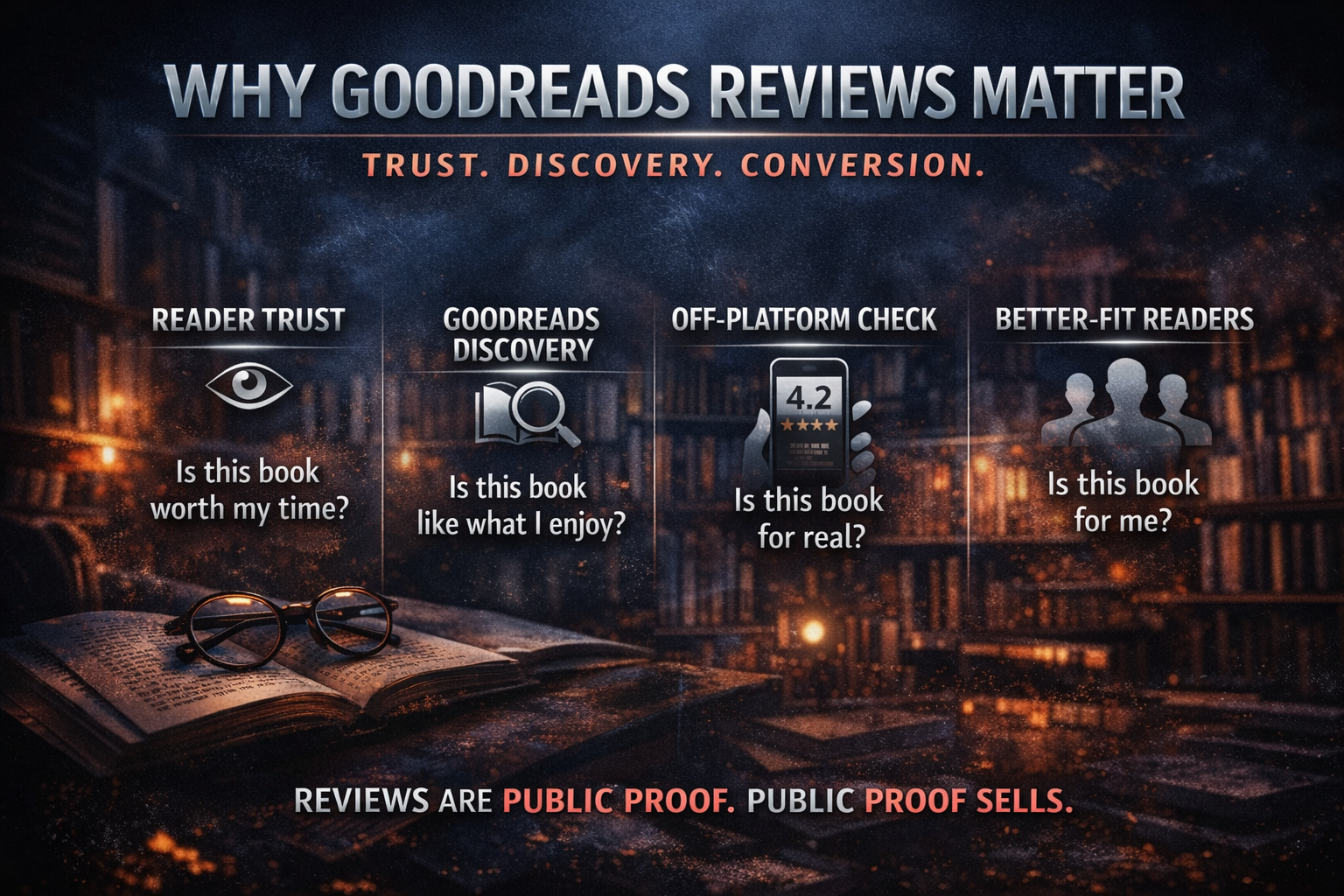
Goodreads is where readers talk when no one is selling to them.
Your Goodreads page is not just a listing. It’s a credibility checkpoint.
When a reader lands on your book page, they scan ratings and reviews to answer one question fast: “Is this book safe to spend my time on?”
Reviews reduce risk. Reduced risk increases conversion.
Goodreads:
A complete guide to every Goodreads visibility mechanism. What each one does, why it matters, and how the platform uses it to surface books to readers.
What reviews influence
1) Reader trust on your book page
What this influences: whether readers keep scrolling, click “Want to Read,” and take your book seriously.
-
Average rating
-
Number of ratings
-
Recent review activity
-
The first few review snippets
2) Visibility inside Goodreads (activity driven discovery)
Goodreads favors books that look alive because readers interact with what’s active.
What this influences: how often your book surfaces next to similar titles.
-
Feed visibility
-
Recommendation pathways
-
Genre browsing discovery
-
List browsing and reader curated lists
3) Better fit readers (and fewer “wrong audience” low ratings)
What this influences: fewer mismatch readers, stronger long term ratings, healthier word of mouth.
-
Tropes
-
Tone
-
Pacing
-
“This is for fans of…”
4) Your book’s “metadata footprint”
What this influences: how your book is categorized in readers’ minds and how it gets connected to the right neighbors.
-
“Dark academia”
-
“Found family”
-
“Cozy mystery”
-
“Psychological thriller”
-
“Slow burn”
What Goodreads reviews don’t do
Reviews are powerful, but they’re not magic
-
Guarantee bestseller results
-
Replace weak cover/blurb/genre fit
-
Force algorithmic success
-
“Fix” a mis-positioned book
The credibility formula readers use
Credibility = Volume + Recency + Believability
-
Volume:
enough ratings and reviews for a reader to trust the average
-
Recency:
proof people care now
-
Believability:
reviews written by real readers in their own words
Credibility benchmarks
These aren’t rules, just common “trust thresholds”
-
5–15 ratings
early stage / unknown
-
20–50 ratings
“real people are reading this”
-
75–150 ratings
established enough to trust
-
200+ ratings
proven audience signal
The real goal isn’t a vanity number. It’s momentum.

Make your Goodreads presence conversion ready
Accurate metadata and clean presentation
Organized editions/series structure
Reader facing page clarity that builds confidence fast
Strengthen trust signals ethically
Steady, genuine reader interest over time
Alignment with the right readers for your genre
No manufactured hype, no pressure tactics
Stop letting your Goodreads page look unfinished
Readers don't need perfection. They need to see that other readers have honestly engaged with the book.
Are you ready to go further?
Contact us to work with Blacksun Book Reviews
Further Reading
-

Claim Your Goodreads Author's Profile
Step by step guide to claiming your Goodreads...
-

Common listing errors
What are the common listing errors and how to correct them..
-

Claim Your Amazon Author's Central Page
Amazon Author Central costs nothing to join, and gives your books a lasting...
-
All guides
Guides for authors who want to understand the market
- Details
- Written by: Blacksun Book Reviews
- Category: Guides

Jump to: timing is primary | The Problem Framed | What Delay Costs | The Correct sequence | Must be listed | Pre Listing | Contact us | more articles
Why Authors Must Be Listed Everywhere
Book discovery is not a passive outcome. It is the product of deliberate, early platform presence maintained consistently across the platforms where readers actually find books.
If your book cannot be shelved, followed, or tracked, it does not exist to the recommendation engines that shape what readers see next.
Why Timing Is the Primary Variable in Book Discoverability
Authors do not lose discoverability because their work is not strong enough. They lose it because they act too late.
The error Blacksun observes most consistently across new and established authors alike is the same: the decision to delay book listings across the major discovery platforms until launch week, or more damaging still until after launch has passed.
By that point, the most strategically important window has already closed. The early shelf-add and tracking phase, during which platforms begin building algorithmic signals around a title, does not wait for an author's promotional calendar to be ready.
The Problem Framed
What authors believe
-
“I will list it once the cover is finalised.”
-
“I will handle platform listings after the formatting is complete.”
-
“I will do it once advertising begins.”
-
“I do not want conflicting metadata appearing before everything is confirmed.”
What is actually occurring
-
Readers search for books before they are published
ARC circulation and advance blogger coverage generate early discovery traffic that has nowhere to land.
-
Reviewers and book bloggers
Require stable, permanent pages to link to. A listing that does not yet exist cannot be referenced.
-
Platforms reward early engagement signals
Shelf adds, follows, saves, want-to-read additions that begin accumulating from the moment a listing is live.
-
A book that is not present across platforms
Does not accrue consolidated discoverability. Discovery becomes fragmented, delayed, or lost entirely.
What Delay Costs: Six Consequences
-
1. Lost Shelf-Add Momentum
Readers who encounter a book before it is listed have no mechanism to save it for later. That intent disappears entirely.
-
2. Broken Launch Traffic
Launch week promotional activity drives traffic to platforms. If only an Amazon listing exists, all other platform momentum is forfeited.
-
3. Weakened Algorithmic Signals
Discovery platforms cannot recommend what they cannot track. Engagement signals must accumulate from the earliest possible date to carry meaningful weight at launch.
-
4. Review and Outreach Complications
Reviewers, bloggers, and ARC readers cannot tag, shelve, or cross-link a book that is not listed. Clean review operations depend on stable listings existing in advance.
-
5. Duplicate and Degraded Metadata
Waiting increases the probability that third-party data sources will populate listings incorrectly before an author has established the correct record. Correcting bad data takes substantially longer than setting it correctly from the outset.
-
6. Missed Early Discovery Loops
StoryGraph prompts, Goodreads shelf additions, BookBub author follows, Hardcover list inclusions these are the primary mechanisms through which readers build awareness of a title before it is widely available.

The solution is not complicated. It requires discipline, early action, and consistent execution.
-
Step 1 — Establish the Footprint
Publish accurate, complete listings across the major platforms as early as metadata is stable. A placeholder cover is acceptable at this stage. Absent metadata is not.
-
Step 2 — Standardise Book Identity
Lock in and cross-check: exact title, author name, series name and number (where applicable), genre and category classifications, publication date, ISBN or ASIN, description, and primary keywords. These must be identical across every platform.
-
Step 3 — Direct All Early Promotion Toward the Footprint
Every newsletter mention, ARC distribution, blogger communication, and advance outreach should include links to the platforms readers actually use to track books not solely to the retail page.
-
Step 4 — Update Rather Than Rebuild
Cover change, subtitle revision, new edition — these are update operations, not listing operations. An established footprint absorbs changes cleanly. A listing created under time pressure at launch cannot.
Where Your Book Must Appear
-

Reader shelves, want-to-read tracking, review ecosystem, author following.
-

StoryGraph Reading tracking, mood and pace based recommendations, giveaways. Five million readers recorded as of January 2026.
-

Author following, promotional network, Featured Deal eligibility, reader notifications.
-

Modern reading tracker, community lists, active growth stage platform.
-
LibraryThing
Long established cataloguing and community platform. Strong library integration, early adopter reader base, and useful for ISBN level metadata correction.
Supporting Presence
Amazon Author Central — Retail visibility, author biography, editorial reviews.
Apple Books / Kobo / Google Play — Retail distribution depending on exclusive or wide strategy.
Author website, book page — The author's controlled source of truth; the page all other listings can reference.
Pre-Listing Metadata Checklist
Before any listing is created, confirm the following are finalised or confirmed as near final:
-
Book title
exact, including subtitle punctuation and capitalisation
-
Author name
exactly as it will appear across all platforms -
Series name and number
if applicable
-
Publication date
confirmed, or best estimate if pre launch
-
ISBN
(print and/or ebook) and/or ASIN
-
Book description
final preferred; near-final acceptable
-
Keywords and thematic tags
aim for 5–10 distinct terms
-
Contributor credits
narrator, translator, editor, where platform relevant
-
Cover image
final preferred; placeholder acceptable for initial listing only
A listing can and should go live with a placeholder cover if necessary. What it must not lack is accurate metadata. Incorrect or absent metadata will be read by algorithms immediately and may persist as bad data across aggregating sources. Cover image can be updated. Metadata errors require active correction and time.
A book that is not present across the platforms where readers track, shelve, and follow cannot build the early signals that determine how platforms recommend it. Discovery that begins late is discovery that has already paid a cost in missed shelf adds, in absent follow activity, in recommendation engines that have no data to work from.
Work with Blacksun Book Reviews
Further Reading
-
Claim Your Goodreads Author's Profile
Step by step guide to claiming your Goodreads...
-
Common listing errors
What are the common listing errors and how to correct them..
-
Claim Your Amazon Author's Central Page
Amazon Author Central costs nothing to join, and gives your books a lasting...
-
All guides
Guides for authors who want to understand the market
- Details
- Written by: Blacksun Book Reviews
- Category: Guides
Jump to: Common Listing Errors | Quick Check| Duplicate Editions | Wrong Identifiers | Bad Series Order | WHEN TO GET HELP | FAQ |
These tiny listing mistakes can make your book invisible
Discoverability isn’t only marketing. It’s metadata plumbing. And when it’s wrong, readers can’t reliably find you, trust you, or buy the right edition.
-
Duplicate
edition
-
Wrong
ISBN/ASIN
-
Broken
series order
Common Listing Errors That Break Discoverability

You can run ads. You can post every day. You can do everything “right”… and still lose readers before they ever reach your book. Because discoverability isn’t just about attention. It’s about accuracy.
If your listings are fragmented, mislabelled, or out of order, platforms don’t know what to surface, readers don’t know what to trust, and your social proof gets split into pieces that never add up
Discoverability Check
Quick scan. No tools needed.
If you answered “yes” to any of that, your book may be harder to find than it should be.
-
Search your title + author on Goodreads. Do you see multiple near-identical entries?
-
Click the editions list. Do ratings and reviews look split across versions that should be the same book?
-
Check your paperback ISBN / ebook ASIN. Do they point to the correct cover, format, and page count everywhere?
-
Look at your series widget. Does Book 2 appear before Book 1? Are novellas scattered randomly?
Duplicate Editions
Duplicate editions don’t feel dramatic. They feel like a minor annoyance. They aren’t. They’re a slow leak that drains your book’s momentum
What duplicates break
-
01
Social proof gets split ratings and reviews scattered across multiple entries
-
02
Search results surface the “wrong” version first
-
03
Links from newsletters, blogs, and social posts land on empty or weak pages
-
04
Readers see inconsistency and assume something is off
Why duplicates happen
-
01
A re-release gets added as a “new book,” not a new edition
-
02
Paperback + ebook are created as separate works instead of formats
-
03
Tiny differences in punctuation, capitalisation, or subtitle spacing create multiple records
-
04
Imports from distributors or third party databases create extra entries
How to spot it fast
On Goodreads (and often elsewhere)
On Goodreads (and often elsewhere)
-
01
Same synopsis, different covers
-
02
Same cover, different page counts
-
03
Multiple “first published” dates for the same title
-
04
Reviews that should be together, living in different rooms
The fix
(without breaking everything)
(without breaking everything)
-
01
Identify your canonical edition, the one the ecosystem should point to
-
02
Consolidate duplicates so reviews and ratings roll up correctly
-
03
Ensure formats are attached as editions, not separate books
Don’t merge blindly. A wrong merge can attach the wrong language edition, wrong ISBN, or wrong publication record. That’s how you create a bigger mess than the one you started with.
Wrong ISBN / ASIN
A reader clicks your book… and ends up on the wrong book, the wrong edition, or the wrong format. Even if it happens only sometimes, it teaches the algorithm and the reader that your metadata is unreliable.
What wrong identifiers break
-
01
Retailer links fail or route incorrectly
-
02
Ads misfire because the item match is unstable
-
03
Readers bounce when the buy path looks confusing
-
04
Incorrect data spreads platforms auto match by identifiers
Why it happens
-
01
ISBN reused across editions that should be distinct
-
02
Paperback ISBN attached to ebook listing (or vice versa)
-
03
ASIN connected to the wrong format or outdated edition
-
04
Old identifiers left behind after a new edition releases
How to spot it
Pick one format (paperback or ebook) and compare across platforms
If any of these don’t match, something is drifting.
-
Cover
-
Title/subtitle formatting
-
Page count
-
Publication date
-
Publisher/imprint
-
Identifier (ISBN or ASIN)


If you only patch one platform, the wrong data often reappears the next time a database sync happens. That’s not your imagination. That’s the chain.
Bad Series Order
If your series is out of order, the reader experience becomes a puzzle. Readers don’t solve puzzles to buy books. They leave.
What broken series order causes
-
Readers start at Book 3, feel lost, quit
-
Recommendation engines suggest the wrong entry point
-
Box sets and novellas confuse the flow (and destroy trust)
Why it happens
-
Prequel labelled as Book 1 when it shouldn’t be
-
Novellas inserted randomly (or not labelled clearly)
-
Series name typed inconsistently across editions
-
How to spot it
Check the series widget on each platform:
Check the series widget on each platform:
-
Are books missing?
-
Does Book 2 appear before Book 1?
-
Does “Book 0.5” display correctly (if you use that)?
The fix
-
Decide your canonical reading order (what you want readers to do)
-
Apply consistent series naming and numbering across all formats
-
Label special cases clearly: prequel, companion novella, side story, box set
Quick Wins That Boost Match Accuracy Everywhere
-
Standardise your author name formatting
Spacing, initials, pen name consistency
-
Keep subtitle punctuation consistent
Colons, dashes, capitalisation
-
Align publication dates
Avoid placeholder dates
-
Separate language/region editions clearly
Don’t let them blur into a single record
-
Use consistent series name spelling everywhere
One typo creates a new entry
WHEN TO GET HELP
You can absolutely fix some issues yourself. But if any of the following are true, DIY often creates collateral damage.
Warning signs
-
You have more than two duplicates
-
You changed ISBNs, distributors, or publishers
-
Your series includes novellas, prequels, or box sets
-
Your reviews/ratings are split across entries
-
Your fixes keep getting overwritten
What our Listing Audit + Cleanup does
-
Full platform scan
Goodreads, BookBub, StoryGraph (4M+ readers), LibraryThing, Hardcover
-
Duplicate
Detection + consolidation plan
-
Identifier verification
ISBN/ASIN per format
-
Series order normalisation
Including novellas and box sets
-
Final
“Clean record” report so your listings stay stable
FAQ
-
Why do duplicate editions hurt discoverability?
Because your social proof gets split. Readers see lower ratings, fewer reviews, and inconsistent search results, so your book looks smaller than it is.
-
Should every format have a different ISBN?
Yes. Each edition and format needs its own unique identifier so platforms can match correctly and keep your records stable. Sharing an ISBN across formats is one of the most common root causes of mis-matched listings.
-
What’s the safest way to fix a wrong ISBN or ASIN?
Fix the source of truth
First your publisher or distributor metadata record. Then correct downstream platforms. If you only patch the platform, the wrong data will reappear the next time a database sync runs.
-
How do I handle prequels and novellas in series order?
Choose a canonical reading order and label prequels and novellas clearly. Consistency matters more than perfection readers just need clarity.
-
Why do fixes revert later?
Because many platforms pull metadata from shared databases or distributor imports. If the underlying record stays wrong, your visible fix can be overwritten silently.
Want To Work With Blacksun Book Reviews?
If you are looking for promotion with more thought, more precision, and more reader awareness, We would love to hear about your book.
Get in touch and tell us about your goals.
Related Articles
-
Claim Goodreads Authors profile
Goodreads is no longer simply a social cataloguing site. Since its acquisition by Amazon...
-
Claim Amazon Authors profile
Amazon Author Central costs nothing to join, takes less than an hour to establish, and gives your books a lasting.....
-
Goodreads
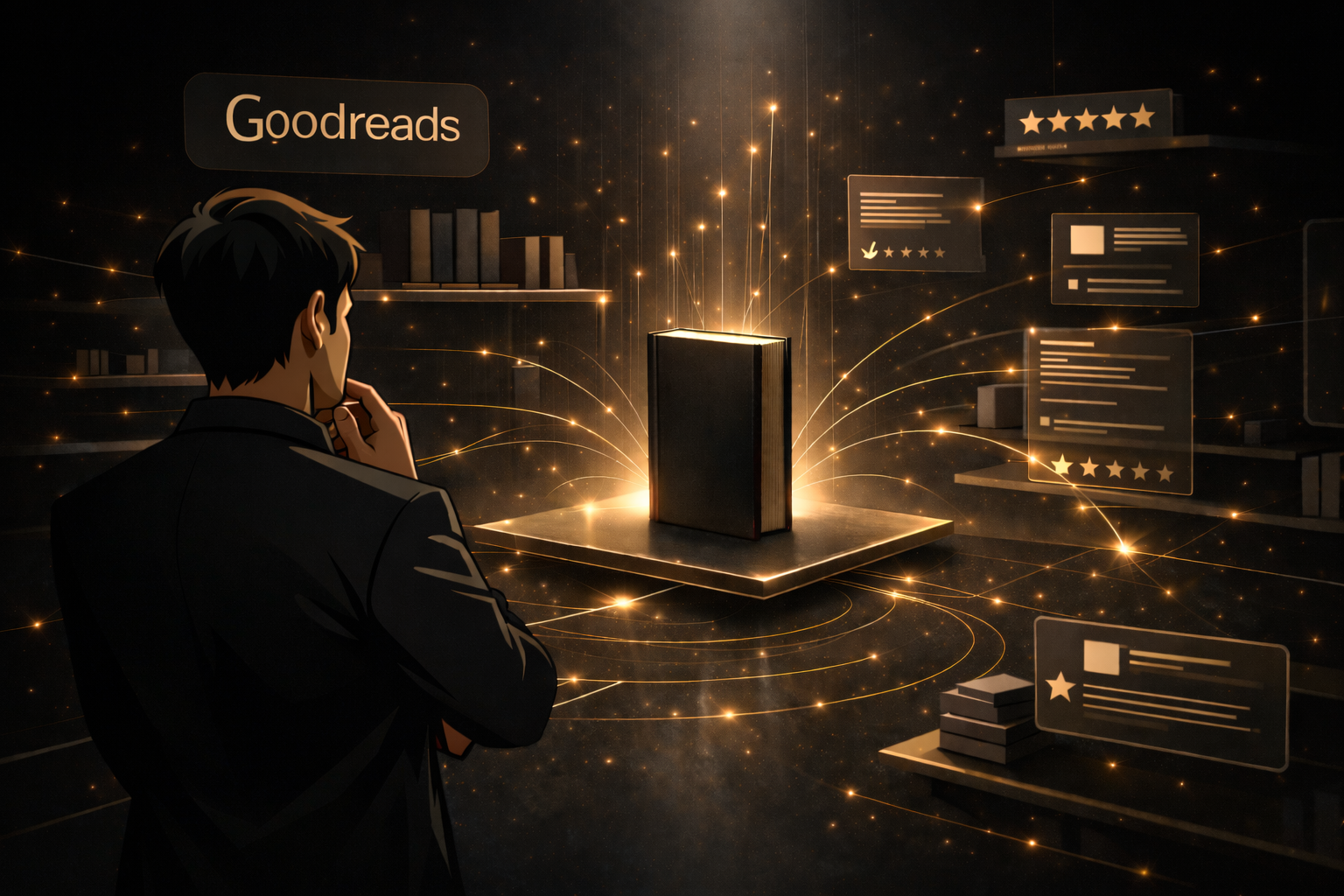
A complete guide to every Goodreads visibility mechanism.....
- Details
- Written by: Blacksun Book Reviews
- Category: Guides